
– (One year follow up) for an overlay E-Max in lower seven and a (3 months recall) for the adjacent lower six restored with direct composite.
– The indirect restoration show amazing result after one year. And healthy tissue were everywhere even above the E-Max.

– These essential steps are obligated in every single case of direct or indirect:
1. Isolation.
2. Good Caries removal.
3. Finishing, smoothing, cleaning and washing. (Including sandplast and airprophy)
4. IDS.
5. RC.
6. Fibers (short and long for more predictable result).
7. Building in layers.
Much More details should be given a caution in, before and after the procedure.
– Some cases of indirect restoration showed more than 20 years follow up. In a study of more than 1000 cases, more than 90% passed the 10 years and the rest failed because of a secondary caries but not a debonding!!!
– We should not forget the motivation for the patient for a good oral hygiene.
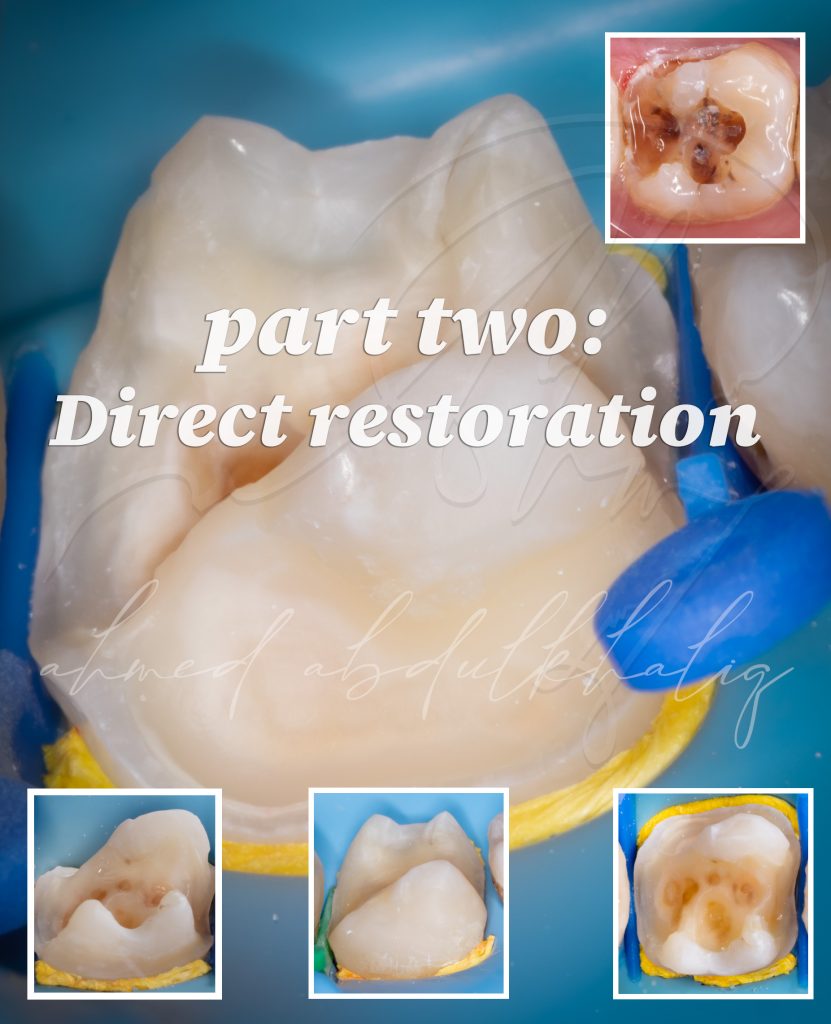
– And a three months recall for lower six with MOD and cervial caries buccally and lingually.
– It is a very big carious lesion. And can be indicated for indirect restoration simply .

– It’s done with direct composite instead for the economic state of the patient and his desire and acceptance. And in a try to save some structure of the tooth and let the fibers do its work which will enhance the fracture resistance and distribution the force which increases the longevity.
– The supported structures were left stand and had been given a chance.
– It’s done layer by layer in two visit and using a different modulus of elasticity in layers with fibers in specific places to minimise, mitigate stress and maximise fracture resistance with cautions to the basic principles of the cavity design.
– If that failed and a fracture in some structure of the tooth occurred after unknown time, simply it can be repaired with direct composite again and there is no harm.
– And according to the desire of the patient that was done. And according, the result of the follow up will be a clinical evidence for two adjacent teeth (in a different structural state) with different treatment plan.
Share on:
