Partial Indirect Adhesive Restorations play a pivotal role in the modern therapeutics, either to overcome the limitations of direct restorations or, on the contrary, to offer the patient an alternative to coronal-peripheral restorations, which are considered to be more damaging to the bio-rim which we are essentially trying to conserve.
Restoring posterior teeth exhibiting large defects (replacing two cuspids or more) with directly bonded restorative composite is possible, but can be very challenging for the dentist, in particular in busy clinical practices where treatment time should be as short as possible1. This is where CAD CAM dentistry plays a crucial role and following is a case report demonstrating its role in today’s fast paced world.
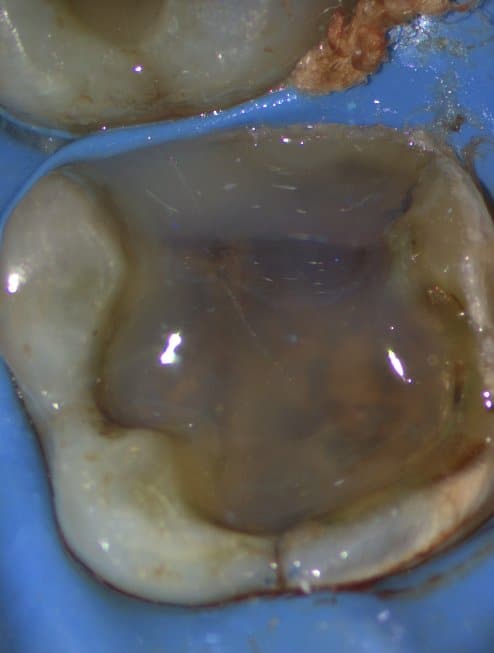
The patient complained of pain in the first mandibular molar during biting. This tooth showed an unacceptable amalgam restoration with caries underneath and a crack at the mesial side.
Large hard tissue losses are frequent in molar teeth depending on caries or aging of the restoration. Due to these reasons, the remaining coronal tooth structure and the functional requirements are important factors to be considered in deciding the treatment planning. 1
Adhesively luted partial ceramic crowns have been documented to be clinically more durable than direct composite restorations when minimally invasively restoring large defects (replacing two cusps or more) in posterior teeth.
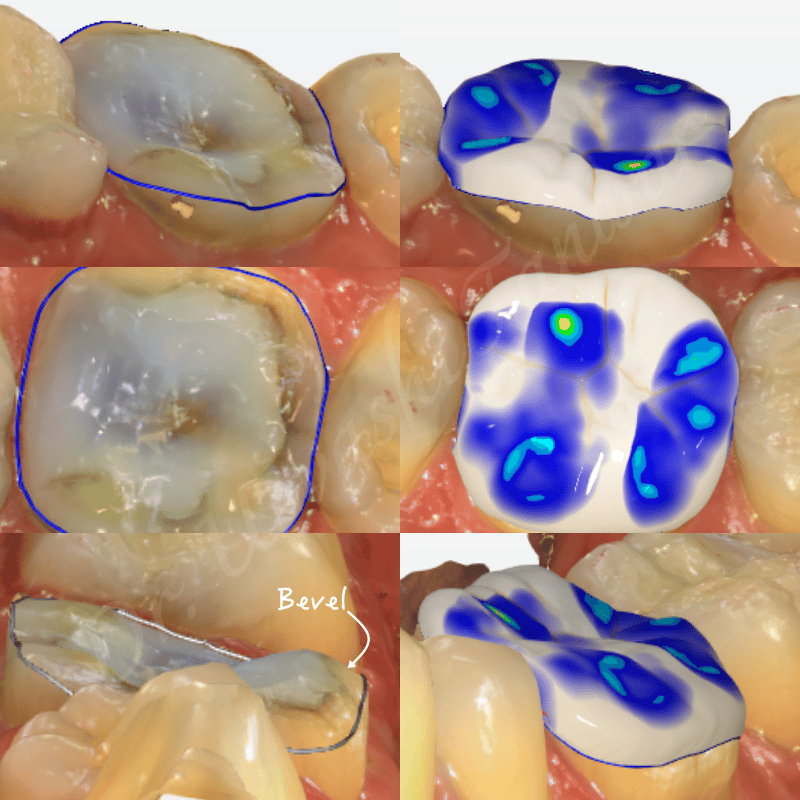
Preparations of the teeth to receive such restorations must be defined accurately. In accordance to that, New guidelines for the preparation form of bonded all-ceramic restorations were formulated by Ahlers et al and Arnetzl and Arnetzl. These guidelines describe eight points of interest which were kept in mind while preparing the overlay:
- Cavities designed for ceramics must have the simplest possible basic geometry
- An appropriate and uniform layer thickness of the restoration is recommended (minimum 1.5 to 2 mm)
- Corners and sharp edges must be avoided
- High tensile stresses should be avoided and must be transformed whenever possible into compressive stresses by changing the prep design
- Stress peaks and sudden changes in cross-section should be avoided by soft and smooth transitions
- Notch stresses must be minimized
- The contact surface with the ceramic restoration must be made as large as possible
- Enamel bordered restoration margins facilitate a stable and adhesive bond of the ceramic restoration via the luting composite to the remaining tooth structure and will thus permanently guarantee better marginal quality
CAD CAM CEREC SYSTEM
Improvements in computer technology, equipments, and restorative materials have made it possible to manufacture an indirect aesthetic restoration in a single visit while the patient is waiting4. The CAD/CAM systems offer many advantages in clinical practice. Customized shaping, definite milling of blocks, adaptation of the inner surface of the restoration which provides precision-fit, replication of the occlusal morphology, producing the restorations chairside and cementing in one appointment are the most important properties of this system. Also, by CAD-CAM system, the errors are minimized, the cross-contamination due to impression and laboratory processes is reduced which is finilized with patient satisfaction.
CONCLUSION
Combined with adhesive luting technique, CAD-CAM Systems create biocompatible, indirect tooth like esthetic restorations in a single treatment session. Based on current data, indirect ceramic restorations luted with adhesive resin cement can be considered as an ideal option for the restoration of tooth weakened due to large tooth loss.
Also CAD-CAM Systems provide to the patient a convenient, well-fitting and durable indirect restoration to the patients. Furthermore, proper case and material selection are critical for ensuring clinical success with overlays.
REFERENCES
- Politano G, Van Meerbeek B, Peumans M. Nonretentive Bonded Ceramic Partial Crowns: Concept and Simplified Protocol for Long-lasting Dental Restorations. J Adhes Dent. 2018;20(6):495-510. doi: 10.3290/j.jad.a41630. PMID: 30564796.
- Frankenberger R, Taschner M, Garcia-Godoy F, Petschelt A, Krämer N. Leucite-reinforced glass ceramic inlays and onlays after 12 years. J Adhes Dent 2008;10:393–398.
- Krämer N, Taschner M, Lohbauer U, Petschelt A, Frankenberger R. Totally bonded ceramic inlays and onlays after eight years. J Adhes Dent 2008; 10:307–314.
- Faria AC, Rodrigues RC, de Almeida Antunes RP, de Mattos Mda G, Ribeiro RF. Endodontically treated teeth: Characteristics and considerations to restore them. J Prosthodont Res 2011; 55(2): 69-74.
- Aquilino SA, Caplan DJ. Relationship between crown placement and the survival of endodontically treated teeth. J Prosthet Dent 2002; 87: 256-63.
- Magne P, Besler UC. Porcelain versus composite inlays/onlays: effects of mechanical loads on stress distribution, adhesion, and crown flexure. Int J Periodontics Restorative Dent 2003; 23: 543- 55.
- Chang C-Y, Kua J-S, Lin Y-S, Chang Y-H. Fracture resistance and failure modes of CEREC endo- crowns and conventional postand core-supported CEREC crowns. JDS 2009; 4(3): 110-17.
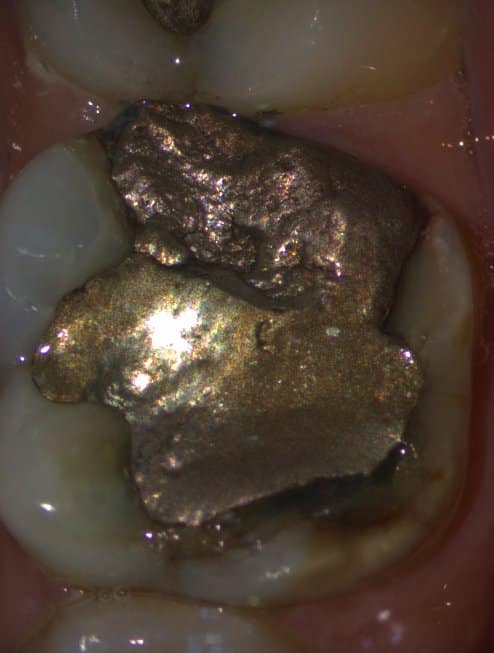
Pre Operative
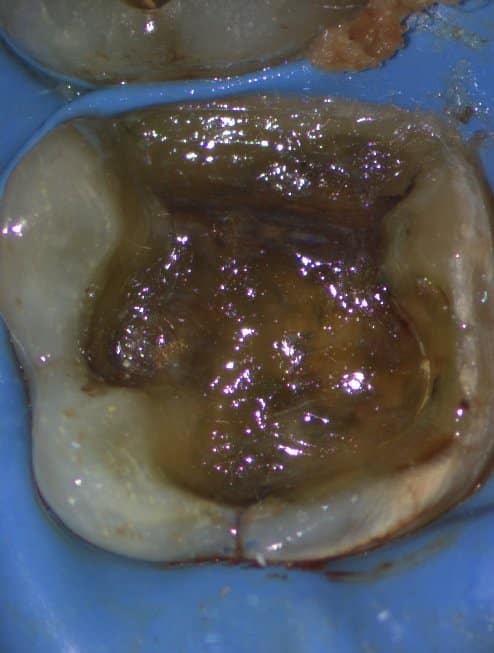
IDS
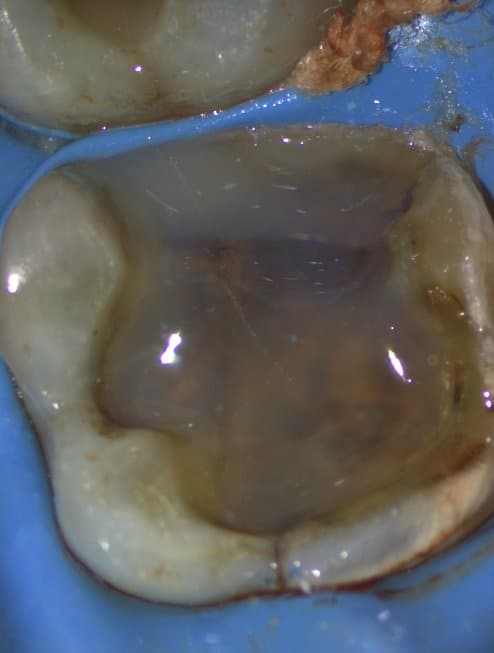
Resin Coat

Final Cementation

Post Op IOPA
Share on:
