A clinical case by our Community member Dr. Vincenzo Vitale.
In the era of Minimally Invasive Dentistry is crucial to spare every sound tooth structure. Below is illustrated a tip to achive this goal.
In a young intact tooth, human enamel presents an outermost layer which is more condensed and aprismatic; and an inner layer also called Ground Enamel. [1]
These two differences can influence the etching pattern leading to be less homogenous. [2]
The instrumentation by airabrasion of the the aprismatic tissue can avoid this problem improving adhesion and removing the unsustained enamel.[3][4][5][6]
The sandblasting procedure is performed under high air-pressure thus becoming a inaccurate and not meticolous step. For this reason, in small restoration is adviceble to use a protector for precious enamel tissue.

Male patient, 16 y/o. Presents a fracture classified as Type A after Spinas(2002) on tooth 2.1. [7]

Color matching using different light-cured composites on contralateral tooth

Isolation with medium thickness latex rubber dam.
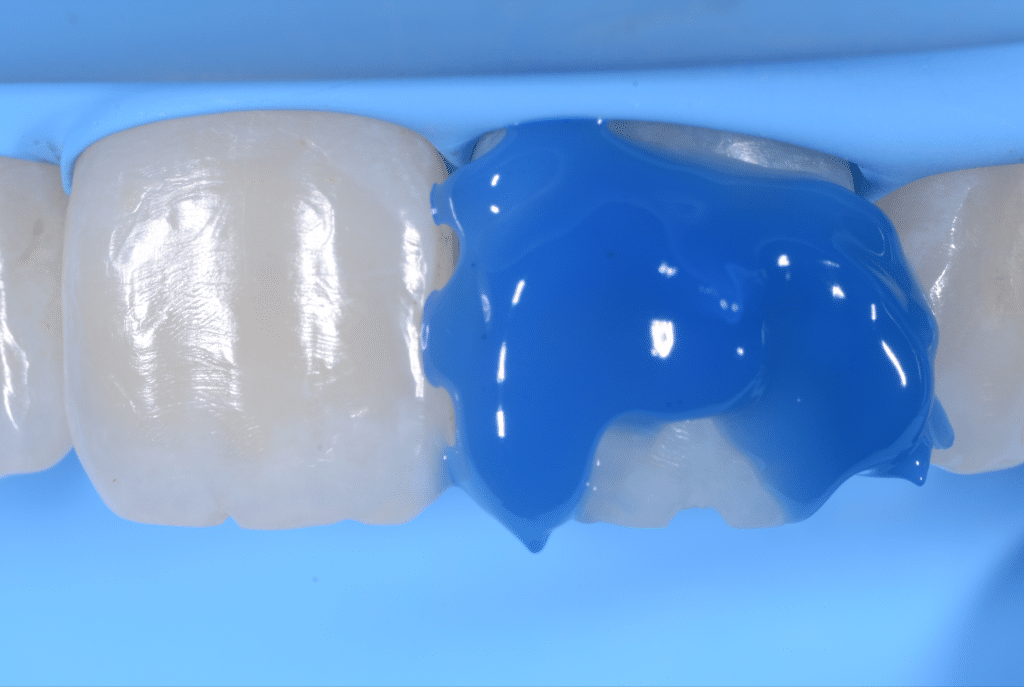
Application and light-curing of liquid rubber dam serving as a shield for sound and juicy peripheral enamel.

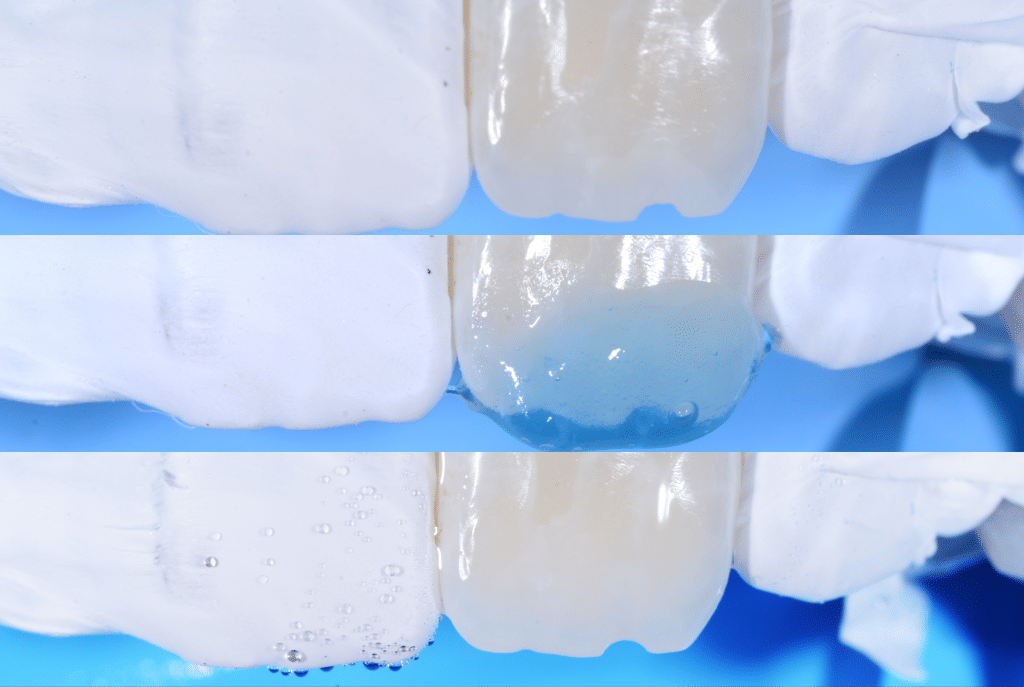
Note the extent of airabrasion performed with 50u Al2O3 for 10 seconds at 2bar. Liquid rubberdam saved more then a millimeter of enamel that otherwise would have been touched loosing strong aprismatic structure and its perikimata and microtexture.

Simply remove the liquid rubberdam with a probe.Particular of the fine and detailed enemel air abrasion. The aprismatic surface area disappears. This enables to etch the cristallites in a more favorable axis and improve adhesion. [5][6]The enamel, its perikimata and the microtexture adjacent to the area of the planned restoration is untouched.
Further move on with the standardized adhesion protocol.

Conclude with composite restoration and your polishing protocols.
CONCLUSIONS----------------------------------------------------------------------------------------------
In cases of extensive reconstructions there may not be a need to be meticulous in AirAbrasion, although it is always recommended.
In particular, in cases of very small reconstructions it’s strongly adviced to invest 30 seconds of time needed to apply liquid rubberdam saving juicy tooth structure, morphology and micro texture.
BIBLIOGRAPHY----------------------------------------------------------------------------------------------
[1] Suzuki M, Takamizawa T, Hirokane E, Ishii R, Tsujimoto A, Barkmeier WW, Latta MA, Miyazaki M. Bond durability of universal adhesives to intact enamel surface in different etching modes. Eur J Oral Sci. 2021 Apr;129(2):e12768. doi: 10.1111/eos.12768. Epub 2021 Mar 5. PMID: 33667032.
[2] Lopes GC, Thys DG, Klaus P, Oliveira GM, Widmer N. Enamel acid etching: a review. Compend Contin Educ Dent. 2007 Jan;28(1):18-24; quiz 25, 42. PMID: 17278628.
[3] Sinjari B, Santilli M, D'Addazio G, et al. Influence of Dentine Pre-Treatment by Sandblasting with Aluminum Oxide in Adhesive Restorations. An In Vitro Study. Materials (Basel). 2020;13(13):3026. Published 2020 Jul 7. doi:10.3390/ma13133026
[4] Mujdeci A, Gokay O. The effect of airborne-particle abrasion on the shear bond strength of four restorative materials to enamel and dentin. J Prosthet Dent. 2004 Sep;92(3):245-9. doi: 10.1016/j.prosdent.2004.05.007. PMID: 15343159.
[5] Nebot D, Goldberg M, Fortier JP, Aldin P. Collage et prismes de l'émail. Importance de la préparation des bords des cavités pour composites postérieurs [Bonding and enamel prisms. Importance of cavity margin preparation for posterior composites]. Actual Odontostomatol (Paris). 1989 Sep;43(167):609-18. French. PMID: 2699701.
[6] Perdigão J, Geraldeli S. Bonding characteristics of self-etching adhesives to intact versus prepared enamel. J Esthet Restor Dent. 2003;15(1):32-41; discussion 42. doi: 10.1111/j.1708-8240.2003.tb00280.x. PMID: 12638771.
[7] Enrico Spinas, Altana. A new classification for crown fractures of teeth. J Clin Ped Dent., 2002; 26: 69-85.
Share on:
